Tuesday, August 26, 2008

Fooling the System

Stella Onochie

Professor van de Stadt

Russian 206-Tolstoy

Final Paper, 5/14/08

Subverting Christian Imagery in Tolstoy’s The Death of Ivan Ilych

Compared to his previous novels such as Anna Karenina or War and Peace, Tolstoy’s post-conversion works read more like theoretical meditations, focused upon the inevitability of suffering. However, despite what seems to be a somewhat drier, didactic style, one feels Tolstoy’s authorial presence more keenly within stories like “The Devil,” “Kreutzer Sonata,” and “Ivan Ilych”—stories where it seems as if Tolstoy had as much to lose, (or gain), as his central characters in the confrontation of their inner torments. As one deeply invested in the same questions that arise in the heart of his Ivan Ilych, he presents himself to us in the caricature of character. Consequently, “The Death of Ivan Ilych” reveals more about Tolstoy’s own understanding of life and religion as interpreted through a lens of death against that of Orthodox Christianity, which he rejected.

As the quintessential “Everyman,” Ivan Ilych is not expected to be as developed as Tolstoy’s novelistic characters such as Levin from Anna Karenina. He is not a singularity. Universality lends itself to generalities— for the maximum amount of readers to be able to resonate with Ilych, his character has to possess attributes that make him no lesser and no greater than any other man. Yet Tolstoy’s conception of resonance with a character does not necessarily equal sympathy. On the contrary, Anna Karenina is an exercise in sympathy. There, we are brought to love a fallen woman, a victim of society’s hypocrisy and apathy, despite simultaneously condemning her selfish manner of living and ending her life. Here, resonance is directed more towards Ivan Ilych’s situation, the end of his life, than the person of Ilych himself. This is perhaps the greatest aspect of his universal appeal—he confronts and experiences death in all of its magnitude for those in self-denial of their own inevitable finitude.

The apparition of death is wholly overwhelming. It comes for all; it is non-discriminating. But death is also an event that remains relegated to a far distant future. When Ilych’s associates learn of his passing, they are quick to leave it undigested. Even his wife continues the denial, acting as though “death was an accident natural to Ivan Ilych but certainly not to [anyone else]” (253). Yet, Tolstoy has Peter Ivanovich perceive Ivan Ilych as a “reproach and warning to the living” (250). Why? The rationale is as follows: the horror of Ilych’s death lay in the fact that it disrupted his complacency, forcing him to consider examining his life, not only thorugh the eyes of a mortal judge, but a supernatural one. And for a man like Tolstoy, described by critic Richard Pevear, (in the preface of Tolstoy’s What is Art), as a “Christian anarchist,” the sudden question of what lies beyond death becomes suddenly dreadful. If Ilych can consider that “Maybe [he] did not live as [he] ought to have done,” then what is to stop one from questioning every conclusion they had made in regards to life, in regards to ambition, and in regards to one’s faith (295)?

Tolstoy, despite his blatant renunciation of the Russian Orthodox Church, believed God existed. But this God was not a “Father” in the traditional Christian sense. Nor was Christ the divine Son, born of woman, and so also mortal. He believed that the divinity of Christ was a myth created by the Church which obscured Christ “true” nature as a mortal man. Yet, the logic follows that if Christ was wholly man, then the cornerstone of the Christian faith—that of the Resurrection and consequently, Heaven— can not exist. The Russian Orthodox Church and the Western Rite Roman Catholics view suffering as a consequence of the Fall, brought into the world through man’s own choice, not God’s initiative. Christ’s crucifixion “sanctified” this suffering, and offered through His resurrection, the peace and hope that life, despite the anguish it can bring, is worth living. Tolstoy, in rejecting this, then brings Ivan Ilych to face death without any consolation or hope in eternity. Instead, like Tolstoy, Ilych begins to place his peace in the finding of his own answers, not God’s answers, to questions concerning the meaning of life and suffering. There is no Christ figure to bring him past death into new life.

At this moment, Tolstoy seems to become inconsistent. The majority of his audience is Christian and yet he himself cannot endorse the doctrine of Christ. How was he to share his own conceptualization of death without relying on this near universal lens through which most view death—Christianity? In order to address this as both a narrative dilemma and conflict of principles, Tolstoy compromised. Ivan Ilych became a superficial Christ figure. Reading through the novella, we encounter numerous juxtapositions of Ilych with Christ. Someone around his death bed speaks, “It is finished,” the same words Christ spoke on the cross. That exclamation is followed by an image of Ivan breathing his last as Christ in His final moment as recorded in the Gospels. Ilych cries to God in his moments of suffering: ‘Why hast Thou done all this?... in a desperate manner shared by Christ, “My God, My God, why have You abandoned me?”(294). But upon closer examination, the connections fall flat. If Ilych is to be Christ like in suffering, then innocence is required. But even Tolstoy does not refrain from pointing out every fault in Ilych’s extremely egotistical character. We pity him because of the suffering he endures, but our pity is accompanied by a cruel sense of judgment or karma—Ilych seems to have received what he deserved. The biblical allusions serve to obscure the death scene, making it palatable. Otherwise, most readers would be made far too uncomfortable by the ambiguous ending. There is no tangible sense of transcendence. Rather, it just feels as if Ilych is falling away, free from the “black sack” but vanishing away in to the light, which is not life or eternal life, but non-existence. As Pevear eloquently writes, “Tolstoy’s heaven is empty. It was this he concealed behind the ‘brilliant edifice of his preaching.’ [Death and heaven are] the abyss of the night in Arzamas, and it is within the prophet himself” (Pevear, Richard, xxii, What is Art?). Life too, its meaning discounted along with the rejecting of the Russian Orthodox Church, is nothing but a blight of darkness. Reasons Ilych, “There is one bright spot there at the back, at the beginning of life and afterwards all becomes blacker and blacker and proceeds more and more rapidly—in inverse ratio to the square of the distance from death” (297). Therefore, the light he sees that fills him with joy is not Heaven, but a morbid realization that death, coming now to free him from life, will throw him into non-existence where pain falls away. Death is “no more” because he simply ceases to exist. Ilych vanishes. Consequently, the allusions to Christ are not there for us to equate the man and Son of God to each other, but rather, to see how they differ. Ilych’s finality is death… Christ offers the Resurrection.

Tolstoy cannot see beyond the "brink of the grave"—life escapes no further than its edge, (Father Gary Caster).

Ivan is sacrificed for the sake of Tolstoy’s dismemberment of death and with it, Christianity’s doctrine of Resurrection. The suffering figure does not always equal the redemptive figure. The true poignancy of Tolstoy’s “Death of Ivan Ilych” then lies in the fact that at least for Ilych, his torments ended, and the answers were no longer necessary, given his abrupt and superficial epiphany at the brink of death. But for a brilliant, but crippled mind like Tolstoy, these questions would continue to bear against him, weighing him down, threatening to throw him into the abyss he dreamt about in his Confessions.

Monday, May 19, 2008

Done!

yeah, so I learned that blogs are really cool-- in theory. Well, no, they are a great thing to do, but it's hard for me because I like to think out my ideas in my head but always have trouble translating out... This was really a fun class and I'm so glad that you offered this to us. Really, the chance to study a single author in depth aids in our discernment of who the author is. I mean, I still have a long, long way to go, many more novellas, treatises, theories, etc of Tolstoy to read if I wish to have a more complete picture of who he is, but I really appreciated and loved this class!

Thanks Professor van de Stadt! And thanks to all of you guys, the Tolstoyian Quadruped, who helped to make this one of my favorite classes!

Hardy and Tolstoy: Brothers?

Professor Cassidy's Comment: And isn't Tolstoy's reaction to the Adam/Eve dichotomy really just a re-encoding of the same problem? By putting women on a pedestal, they simply don't have the chance to be what they are for themselves and what they want to be. Although he tries to penetrate the souls of the female characters he creates, he ultimately gets tripped up by the drive to make them creatures whose female biology determines them in a way that male biology doesn't determine his male characters.

It's amazing how everything comes together. So I'm taking English 333-The British Novel alongside this class and am writing a final paper about Thomas Hardy's Tess of the D'Urbervilles. Simply put, it was like reading Anna Karenina over again but this time, with Hardy's voice in my ear yelling, "But Tess has no agency in her sexual fall! She is blameless-- Anna got her's!"
But both their stories end in death; for Tess, it is twofold. Anna's self-destructivity ends in her suicide, her crime remains adultery. Tess's crime is murder, but before that, she did achieve a social appeasement for returning to her "rightful" first husband, Alec d'Uberville. Does it matter that the man only receives the title of her husband because he first rapes her? Society is portrayed in both novels as a cruel beast that allows, even encourages such awful happening. Justice for them is as blind as d'Uberville's mother, as Tess's father, and as the provincial Clares.
Yet, both Tolstoy and Hardy move with the same agenda-- to depict the depravity of their modern society and the "falls" it breeds for women. Society bears the greater blame than either woman for their fates. However, that is where Tess and Anna's similarities begin to fade. Anna is emotionally starved and willingly initiates the affair with Vronsky, although she feigns to be unconscious of its initial development. On the other hand, Hardy presents Tess as a woman whose "fleshy tabernacle" of a body "rivets" men's eyes upon her, distorting her true identity to their own needs and desires, despite her own innocence and unconscious seduction of male attention. Tess is a woman who could spend her whole life running it seems, away from men and their hungry gaze but still be blamed as the seductress. Who then, is more innocent? Who deserves are greater sympathy?

I, for one, actually feel more inclined towards Anna because of her waverings between her children, (family), and her own self-consuming desire to be loved, (albeit in the wrong, most destructive manner). She seems more realistic. I don't really think Tess was as oblivious to the intentions of men as Hardy makes her seem. For one, even Hardy seems only able to focus on Tess's physicality and sexuality. It is always her lips, (besides her helplessness and large bust), that his descriptions gravitate around. His angelic Angel Clare, (haha, see I just made a horribly obvious pun), paints Tess into this pagan spiritualized woman only to become obsessed with her beauty:

"How very lovable her face was to him... And it was in her mouth that this culminated.. her mouth he had seen nothing to equal on the face of the earth...that little upward lift in the middle of her red top lip was distracting, infatuating, maddening.”

I think Tolstoy and the fictional Clare fought the same battle: confusing natural attraction and love with lust, entrapped within one's incessant meditation and struggle involving internal censorship. Professor Cassidy, van de Stadt, and all that we, as a class have come to in regards to a conclusion are correct: woman cannot escape the fatalism of a sexual fall if society makes it so that she is always revered for her "fleshy tabernacle" at the exclusion of her spiritual soul...

More about Pozdnyshev.. My Ranting Continues...


I do hope the deadline for completing our posts was today... I don't have the syllabus and internet is finicky at our house, (we have to go to the library), and I'm in the midst of another final, but I'll try to finish this today :)

The character of Pozdnyshev himself is a cast off of Dicken's own two-dimensional characters, ridden with caricatured facial tics, twitching arms, and corporeal agitation, (thank you Professor McWeeny for describing Dickens like that, lol). The man does not breathe. Pozdnyshev's words rush out as he confesses not out of a desire to seek forgiveness for murder, but for his failure to be that “terrible” figure that succeeds in removing carnality from life.

This is another reason why I did not find Hadji Murat as compelling or likable as others. It's “framed” construction seemed almost chosen because Tolstoy grew tired of his creativity. That was not worded very clearly nor does it allude to what I found at fault with the novella, but the story did not seem to know really what it was saying. Yes, the outside, religious Other happened to be more civilized and moral than the Russian aristocracy, but other than that, what was Hadji Murat? If it was a stance against sexuality like Pozdnyshev, then wouldn't the polygamous Murat be condemned also?

It is sad that as Tolstoy descends deeper and deeper into this neurotic assault against what it means to be human, he displays the very tragic flaw he desperately hoped to root out: his own human imperfection, his “sins” as it were. Tolstoy seemed to feel as if a lack of perfection, perfection being the ability not only to think what is “right” but to ALWAYS “do” what is right,”`was equatable with a death sentence as we see in The Devil where the man kills himself in ending one, and then his mistress in ending two. Death becomes a way of evasion. Death becomes a deceptive savior... Tolstoy is at the end of his rope as he dreamt in The Confessions and I fear that his tightrope snapped.

He was right to condemn conjugal relations when they were based out of lust and a selfish desire for stimulation and physical pleasure. But the essence of conjugal union is not selfish but wholly self-less. It is the image of sacrifice when respected and revered as both the physical but simultaneously spiritual and mysterious union it is.

Thursday, May 15, 2008

The Post-Conversion Tolstoy= More Personal?

Taken from a Wikipedia article on the Kreutzer Sonata:

During the international celebration of Tolstoy's 80th birthday in 1908, G. K. Chesterton would criticize this aspect of Tolstoy's thought in an article in the September 19th issue of Illustrated London News, writing: "Tolstoy is not content with pitying humanity for its pains: such as poverty and prisons. He also pities humanity for its pleasures, such as music and patriotism. He weeps at the thought of hatred; but in The Kreutzer Sonata he weeps almost as much at the thought of love. He and all the humanitarians pity the joys of men." He went on to address Tolstoy directly:
"What you dislike is being a man. You are at least next door to hating humanity, for you pity humanity because it is human."


So, from Professor Cassidy's comment, I thought a good final paper would be something that combined Tolstoy's Ivan Ilych, The Devil, Kreutzch's Sonata, and the Confessions with a pinch of What is Art?, all different facets of his post-conversion self so that I would be able to better understand his final thought on death and dying, eternity, etc that comes through so darkly in The Death of Ivan Ilych.

But, I wasn't able to go through everything! I read The Devil and both of its endings before moving on to The Kreutzer Sonata. But 3/4 of the way through, I felt so overwhelmed by the incessant, wayward rantings of the anxious and near-crazed Pozdnyshev that I did something I never thought truly possible...I stopped reading Tolstoy.

For an author whose work I greatly respect, whose powerful depiction of the abyss that results from the dismemberment of his faith into barely disguised nothingness frightened and has captivated me since I was a child, (that one could struggle against so much for so very little...), I definitely thought that, despite my disagreements which his conceptions of a godless religion, (for that is what he ended up with), his influence would be something I continually valued.
But as Tolstoy aged, the man became someone so tortured and ever so deluded by his own graspings after an ideal, unrealistic world, a world where the "body" is condemned and one faces hell for desiring what is natural and good in marriage-- conjugal love. Tolstoy lost sight of himself.
And I hope I don't sound so condemnatory towards Tolstoy myself, but his stories ceased to be works of art but disintegrated into frantic attempts to validate himself through the approval of the outside world. If his theory of sexuality is only disseminated out to the greater world, then peace would be achieved. In blatant violation of his own conception of what art is, he hijacks the fictional medium for for his own agenda. Yes, writing of any kind is inherently selfish-- selfish in that it usually circles back to the author who hopes that the reader receives something in the form of a word or textual experience that he, as author, hopes beneficial. But the methods of these type of “readerly conversions” should never be one of enforcement. Tolstoy, thinly veiled under Pozdnyshev's voice, speaks to put down every voice that rises in opposition of his theories. The people of the train car are particularly not the best candidates to represent the common world, (the woman is so horribly educated, aristocratically simple, etc and the men aren't much better). And the narrative construction of the long, LONG train ride and extremely helpful narrator as a means of giving Pozdnyshev the necessary, uninterrupted time to speak his sermon/story is almost amusing. Really, it is Tolstoy just having a conversation with Tolstoy.

Monday, April 28, 2008

Self-Perfection?

“The only possibility to live within the spirit of the living God is to accept the truth that we cannot resolve, we cannot fix, we cannot eliminate the imperfections of our life. If we could we would not need a Messiah. And so many people think “I’ll take on a spiritual life and then my life will be perfected.” No it won’t. You’ll just be busy with yourself...and that’s hell.”
-Father Gary Caster, Williams Catholic Chaplain, Jan. 2008


I also wanted to comment more about Tolstoy's idea of "perfecting" oneself, (specifically one's morality). It seems an idea that starts off like a bucket full of holes. Person A, being imperfect, wants to make himself perfect, but really-- how? How is a finite being truly able to reach such an infinite standard without the aid of something, someone equally infinite-- God? Tolstoy does not look to God for help. Rather, he reasons that once he perfects himself, faith in God will come, a faith and understanding greater than that of the Russian Orthodox Church. But this seems more of a self-obsessive gesture-- its underlying purpose is to seek a reward-- an end to suffering. This leads us back to his short story, "The Death of Ivan Ilych," his first fictional work written after the "Confessions". What does Ivan Ilych want? "To live and not to suffer..."(294). It's a desire we all share, united by a connecting sympathy that makes pain, especially that suffered by innocents, resonate deep inside us. And as Ilych lies in bed, tormented by "his helplessness, his terrible loneliness, the cruelty of man, the cruelty of God, and the absence of God," he cannot help but ask "Why has Thou done all this?"-- what is the purpose of his suffering? I can only make sense of this through my experiences and those come solely out my life as a Catholic. It is difficult not to fall into thinking that God is a God of affliction, tormenting the short breath of the lives we have with an anguish and suffering He himself seems immune to. But really, it's more like we're joined with God in suffering-- how is He immune? He underwent the same agony as us-- the pain of suffering though innocent, of feeling abandoned-- "My God, my God, why have You forsaken me?" And though He possessed the power to "perfect" Himself, (Christ easily could have taken himself off of that cross), but instead, remitted that power to God, His Father... There is no such submission in Tolstoy. Instead, I feel that his own intellectual/spiritual struggles hardened, stiffened him in such a way, that if he were ever made to bow to anything, his back would snap.

Then, if human perfection is impossible on our own, why are we instructed to "be perfect like [God] is perfect?" I am not a theologian, so I cannot adequately address this question. But I do think it has something to do with one's ability to be humble, because love is ultimately self-sacrificial and humble. It's a simplistic answer, but the best I can do without increasing the risk of misspeaking...

“A spiritual life is a life lived listening. To listen, we cannot be distracted by our desire to be perfected...”

-Father Caster Jan.2007

The Problem of Humility


Humility is a beautiful, transcendent disposition of the human spirit towards knowing yourself-- towards understanding yourself to the very heart of your soul in a way that serves not only to raise you up, but also those around you. The caricature of humility as a person without a spine, cowering to any figure above them, unrestrainedly self-deprecating, is simply incorrect. Life becomes disturbed by a constant, gnawing anxiety for exterior affirmation, and unlike the true virtue of humility, such falsity leads a person to become more buried within themselves, suffering from a lack of true human connection. That is what I gathered from Tolstoy's Confessions-- he is a man suffering from an inability to truly connect with the world and its people. "Ambition, love of power, covetousness, lasciviousness, pride, anger, and revenge"-- these are only temporary distractions and never serve to console for long. It was right that Tolstoy rejected these things... but the idea of "self-perfection" that he replaced them with seems to have been more damaging.
The basic confessional-esque structure is typical for religious works, (yes, sorry, it's an obvious point, but just needed to put it out there). It is usually written, first and foremost, out of love of God, and submission to God, in order to edify others-- to teach through one's experiences. It is a inherent understanding in the Catholic Church that one of the most genuine, authentic ways to share one's faith is to speak through one's experiences, one's actions, first. People can use all the rhetoric they want, but if we can't see any physical, positive evidence of that faith in the life of a person, then really, what good is it? Tolstoy's earnest desire to understand life, to learn its meaning so as not to be mislead by fleeting distractions is good. It's what moves all of us. But somehow, he transforms his desire to know, to quantify, and possess the "mystery" of life-- specifically our disposition towards the spiritual-- into a towering edifice that overshadows his whole life, especially his faith.

I say this because Tolstoy's Confessions reads not as a heartfelt revelation of love or devotion to God, but more like something that circulates back into itself. There really is no progress, but the semblance of movement... a self-seeking cycle. His conclusion attempts to persuade us that his questionings finally resulted in an epiphany about God and life, but the final result seems lacking. In class, I drew comparisons between Tolstoy and St.Augustine, as men who suffered through the beginnings of their lives, aching to fill their hearts with substantive truths. But St.Augustine looked to God for direction, and through his faith, found peace. Tolstoy, on the other hand, rose himself and these questions to such a height that they became almost god-like, supplanting the place of the Christian God. But even after realizing that he could not attain all he wanted through reason, he still chooses to evade confession-- the true confession that he did not possess the answers. And this obsession to be not only Thinker but Possessor of all intangible knowledge, (and what is more mysterious than the meaning of life?), is destructively indulgent.

Every man and woman desires to understand why it is they are here, what the purpose of their lives are. To say that not knowing what one is supposed to be breeds little anxiety is an understatement. But in the Catholic faith, the purpose of one's life is described in words so small that it seems oversimplified, but they're true. The purpose of one's life is to love, to love God in whatever capacity/way we are called to. And to love God is to love ourselves and all those around us in the way He loves-- humbly. Fully. Completely. Tolstoy's anxiety prevents himself from ever being capable of giving himself fully to others. He desires to be part of the collective heart of peoples, the pulsing mass, alive and circulating throughout the world. But his own conceptions about himself, as this great man not really meant to be pupil but Teacher of all reminds me of Ivan Ilych. The judge cannot really see himself among others as an equal, but always as an authority. The same occurs with Levin, despite how much he wants to break down barriers between himself and the muzhiks. Consequently, all of what he does to know God is distorted by a desire to capture God. "[His] heart is restless O God," until God "rests in him."

For Tolstoy, humility is a problem because he doesn't know what it is. He understands the idea of it but cannot get himself to truly believe and encapsulate it. And his Confessions definitely reveal this misunderstanding for in bringing you back towards him and not God, Tolstoy ruptures the meaning of "confession" which is the very essence of humility.

Letter to Darius (A.D. 429)- St.Augustine

Thus, my son, take the books of my Confessions and use them as a good man should--not superficially, but as a Christian in Christian charity. Here see me as I am and do not praise me for more than I am. Here believe nothing else about me than my own testimony. Here observe what I have been in myself and through myself. And if something in me pleases you, here praise Him with me--him whom I desire to be praised on my account and not myself. "For it is he that hath made us and not we ourselves."[5] Indeed, we were ourselves quite lost; but he who made us, remade us [sed qui fecit, refecit]. As, then, you find me in these pages, pray for me that I shall not fail but that I may go on to be perfected. Pray for me, my son, pray for me! (Epist. CCXXXI, PL, 33, c. 1025).

Thursday, February 21, 2008

Entering into Suffering: Why Does the Societal Entrance Entail Pain? Family Happiness...

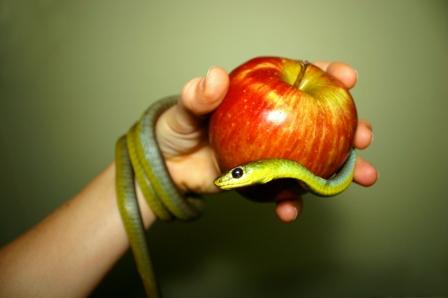
"Think of the orchard scene... doesn't it appear to have "shades of Genesis" about it?"


As we have encountered time and time again in the works we’ve read so far, it seems as Tolstoy struggles with a Catch-22 in regards to a girl’s maturation into womanhood: to remain a pure woman, one must avoid society, but to be a “woman” in the sense of realizing one’s sexuality, the entrance in to society becomes an important, if not crucial, training ground for learning how to “control” one’s passions.
We first encounter this dilemma in Family Happiness at the moment where Másha and Sergéy first realize their romantic feelings for one another. Watching him lose himself to private ruminations in the orchard, Másha suddenly desires to overcome the barrier in between them, in essence overstepping the man-made wall and boundaries set in place. But her unexpected entrance into an orchard “fraught with shades of Genesis,” (Van de Stadt), seems rather an invasion in to a world of temptation. And it is one Sergéy, as a man, navigates easily, while Másha is foreshadowed to stumble.
As her guardian, Sergéy is in control of her entire estate and even her future as a father-like substitute. He evokes in her feelings of love that seem to cross into an almost worshipful consolidation of his father, guardian, and all-knowing qualities. To Másha , Sergéy becomes a god, and this is perhaps the most damaging to their budding relationship. No longer simply a man, Sergéy controls Másha ’s devotion. They are not equal but have already instituted the social hierarchy within themselves where Másha ’s role is to be fearfully passive, and Sergéy, unquestioningly dominant. She ignorantly imagines that this “fear was love” and that due to it, she would be “happy in his power over [her]” (42). Natasha Rostov echoes a similar desire, referring to herself as Anatole’s “slave” and he, her “master” (War and Peace 577). But having never entered society, uninitiated into the adult sphere, Másha constantly depends on Sergéy to be her lens through which to see the world. Consequently, it logically follows that with such a responsibility, he should continue his role as “Guardian” in addition to that of “Lover” in order to teach her the social script.
But for all of Sergéy’s omniscience about her fate when he sees how attracted she is to society, he allows her to fall and, to us, this seems inexcusably cruel. A question surfaces, one repeated often in a world during moments of incomprehension, not simply the question of “Why do bad things happen?” but rather this: “If we are loved, watched over, and guided by one who fully knows—is fully aware of what we will do and the consequences we will have to endure due to our actions—how can he not save us from what feels like pointless, cruel suffering?” Sergéy is all of these things to Másha —he loves her, he has watched and guided her since childhood… and yet, he quickly seems to cast her aside to her own destructivity only to blame her for it later. We could call it “salutary neglect” on his behalf, or simply regard it as abandonment, which is certainly what Másha feels. She is constantly threatened by the societal structure that labels man guardian, lover, god, and judge while she remains “woman,” a role that is ultimately human, too much so in its failures and desires.
In his defense, Sergéy didactically reveals to her that his absence allowed her to “have personal experience of all the nonsense of life, in order to get back to life itself [because] the evidence of other people [would have been] no good” (Family Happiness 79). And from a Christian perspective, there is an element of truth to what he says. However, the appropriate Christian action would have been for Sergéy to have spoken compassionately to Masha in the hopes of changing her mind. If that failed, then he should have at least forgiven her at the end. But his aloofness illustrates his unwillingness to change or concede his own guilt. Instead, he uses their broken marriage as a further reminder to Masha of her wrongs. Sergey is a counterfeit god, offering condemnation, but no hope. He is all stagnancy which blatantly opposes Christianity since it is supposed to be a lifetime of conversion.

This contemporized retelling of a woman’s fall from grace, like Eve, occurs because the women were not inwardly satisfied with the lives they already had. Like Eve, it appears that the blame was due to Másha ’s own folly for destroying their happiness that began in the orchard. However, Tolstoy’s fascination and sympathy with female characters encourages me to believe that it was not his intention to “vilify” Másha as centuries of misinterpretation have lead many to believe about Eve. Rather, pride is the underlying reason to explain Sergéy’s absence, not because of his divine-like desire to grant her “free-will.” Sergéy is a man—one entirely too used to being in unquestioned control of a woman, the object of his affections. And when she begins to move away from him, he feels helpless. Tolstoy examines this again in again in Natasha Rostov and Andrei Bolkonsky and Anna Karenina and Alexi’s relationships. When it seems as if events are not within the control of the men, they vacate, in order to not reveal their weakness or even the power that the women have upon them. Sergéy removes himself to the background because he does not think he can compete with others in the social world. Even if he looks down upon them, he still cares about what they will think about him in regards to Másha . He cannot deal with this threat to his reputation and so attempts to live a separate life. But more so, he cannot face the fact that he may be complicit in the problem, and so, like Alexi, treats her fall in a manner that renders it “impossible to say what needed to be said to her” (Anna Karenina 149). Another antiquated form of the universal "cop-out"? Yep, most likely...

Monday, February 18, 2008

Happy Ever After? Coninued...


Oh, I just wanted to add that this title still seems more fitting because the story centers on the relationship between the two, Masha and Sergey, and only turns to the children of the marriage, (and even Kataya and Sonya), as a digression away from the heart of their troubles. Almost like, "well, we've pretty much screwed ourselves up as lovers, so the only thing left to do is be parents... Woot?"
I think I'm starting to adopt the majority of the class's opinion, (Sorry Tommy), that the ending was more of a cop-out, a further dismissal of responsibility, similar to the way that Olenin tried to discard his past. To put it bluntly, it seems seems that if one tries to forget his past, he gets screwed up like Olenin, if one tries to live only in the present, they have to force time to obey their constraints, like Sergey, and if one tries to live, pursuing only the future, they risk losing what they have already gained...

Eh? Sorry for rambling...

Happy Ever After?

Fairy tales stand as romantic visions of unchangeability. In such worlds where time ceases to flow, merely pooling around the concluding moment, the future exists to provide only that which further ornaments the characters' luxuriously indulgent love.These are stories of constancy... but also of stagnancy, whose connotation calls to mind a sense of spoiled movement.

Másha as well as Sergéy, despite the sagacity of his age and the wisdom that supposedly entails, allow themselves to be "carried away" by the promise of the fairy tale. They enter in to marriage with such idealistic expectations: the outside world will never change; its consequences or temptations will never enter in to their romance. The future can only be a continuation of their "playful" love-- of a perpetual spring time with all of its "dreams and vague hopes and desires" (Tolstoy 8).

But winter is inevitable (Tolstoy 48). For both of them, the coming of winter brings fear, (Molly's comment from class), threatening what they believe to be the full expression of their love. But a love based on feeling already evokes a certain sense of finitude because feelings are transitory things. They are utterly reactionary and as we all know, love sometimes invites the paradox where you may love someone without necessarily "feeling" like you love them at the moment (remember Kim's comment from class?).

I think you can feel Tolstoy interjecting at moments like this as he observes his characters' futile attempts to still time. The reader is constantly bombarded with images of the passing seasons: autumn, winter, spring, summer... Tolstoy inserts us in to the cycle of seasonal life only to make the progression towards change seem inevitable for Másha and Sergéy. Change is necessary for survival. It is the promise of adaptation that allows Nature to get through "dark and sad" winters (Tolstoy 3). But without adaptation, there can be no true flourishing. The lilac-bush that lingers throughout the story survives the cyclic passage of the seasons, from its spring infancy to the desolation of winter. And when Sergéy reasons that "Each time of life has its own kind of love," (Tolstoy 78), I am reminded of Ecclesiastes 3:1,4,8-- "To everything there is a season... a time to dance... a time to love and a time to hate." That book of the Old Testament portrays life as empty if pursued only for its "vanities" which, I think, is how we're supposed to view Másha at the novella's end. She enters marriage, seeking her "Happy Ever After" and not finding it there, enters society where she is "lead astray" by the vanities of the socialite world. Although the ending makes it seem as if the two salvaged some form of contentment from what was left of their marriage, Másha seems to have been dealt with harshly as Kim and Molly described in class.


But turning away from my digression, I think the alternate title resonates with the reader more than "Family Happiness" because it sets us up to hold the same expectations as Másha. We enter and share more with her character than Olenin's, partly because everything is filtered through her eyes and not a disembodied, omniscient entity. We feel her distress and poignant confusion when her life's story does not unfold in to bloom like she imagined. And really, we can sympathize with Másha disillusionment...especially when society seems to lend itself to pursuing her same, initial understanding of what
love is.

"To make life a romance is the one thing worth doing." (Tolstoy, Family Happiness 68).

(Not that I agree, but I do that alot...)